Economic Forum on Central and South-East Europe 2025 “Shaping the Future of Central and South-East Europe: Policy, Business and Innovation towards 2030”

Economic Forum on Central and South-East Europe 2025 “Shaping the Future of Central and South-East Europe: Policy, Business and Innovation towards 2030”
Published: October 26, 2025
Event summary
Anna Orosz
Head of Research and Senior Researcher
Event Summary
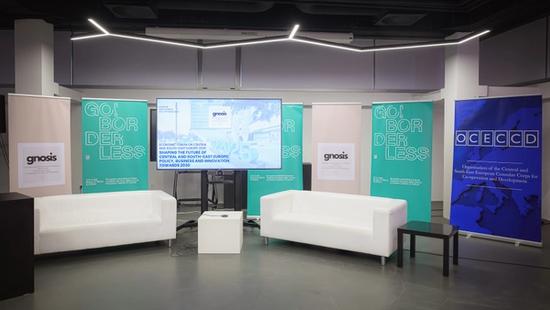
The Economic Forum on Central and South-East Europe was launched last year by the Organization of the Central and South-East European Consular Corps for Co-operation and Development (OCECCD) – the founder organisation of Gnosis Institute – in order to bring together policymakers, business leaders, and scholars to discuss how the development potential of the region could be strengthened in a holistic approach. In 2025 Gnosis Institute took over the organisational role of the Forum which was held with title ‘Shaping the Future of Central and South-East Europe: Policy, Business and Innovation towards 2030’ in Nova Gorica – Gorizia, the European Capital of Culture on 21 October 2025.
In their welcoming remarks, Erik Molnár, jr. General Director of Gnosis Institute and Anna Orosz, Head of Research underlined the symbolic value of the venue chosen for the Economic Forum in 2025 which focused on the importance of regional and cross-border cooperation as well as EU integration and enlargement in promoting the region’s progress and in addressing multiple parallel challenges in a volatile and rapidly changing international environment.
In his keynote speech, H.E. Mr. Aleksander Geržina, the Director of the Bled Strategic Forum of the Ministry of Foreign and European Affairs of Slovenia and former Ambassador of Slovenia in Vienna reminded the audience based on the experience of the divided towns of Gorizia and Nova Gorica that although wounds may have arisen from time to time, they could be healed through enduring coexistence and shared prosperity. Cross-border cooperation is also in the heart of EU integration, just like reconciliation which happens when political will finally meets the human desire to overcome past divisions. The Ambassador insisted that the EU was finally not about institutions, but people and the process of enlargement should not have been viewed as a favour, but as an act rooted in deep confidence in the region’s future and security. Cultural diversity must not be abandoned, he added and it should be preserved and used as an advantage, surpassing the paradigms of the past. Only cross-border personal connections can bring an end to hostilities and build trust. This development must proceed step by step, person by person, until everyone realises that borders are not meant to divide people, but to be overcome through their free choices. The true power of the European Union, therefore, lies not in its institutions but in its people.
The first panel entitled „Europe Reconnected – Regional Cooperation and EU Integration” focused on the state of regional cooperation in the SEE6 and the region’s EU integration prospects in terms of the goals to be reached by 2030. Ardian Hackaj, Research Director at the Cooperation and Development Institute in Albania, delivered a comprehensive overview of the current dynamics shaping the Western Balkans, touching on a wide range of critical issues—from institutional reform and economic integration to security cooperation and democratic resilience. While he highlighted numerous key points essential for the region’s collective advancement, he stressed that the cornerstone of all future progress lies in one fundamental element: trust. According to Hackaj, building genuine, sustained trust among the countries of the Balkan region is not only a prerequisite for deeper regional cooperation but also an indispensable condition for each nation’s individual path toward European Union integration. He emphasized that without mutual confidence, shared initiatives—whether in infrastructure, trade, justice, or security—will remain fragile and ineffective. In this context, he affirmed Albania’s strong motivation and active commitment to nurturing this trust through transparent governance, regional dialogue, and consistent alignment with EU standards and values.
Tanja Bošković, Project Leader for Regio Trade of Deutsche Gesellschaft für Internationale Zusammenarbeit underlined that significant positive changes has been achieved over the decade, although she also admitted that the progress slowed down in the last couple of years, mainly because of political circumstances. Institutions and businesses work and function much better than before, and data sharing improved a lot, thus facilitating increased level of regional and cross-border cooperation. Waiting time on the borders and operational costs decreased significantly but the achievements are uneven in the SEE6. On the other hand, she insisted that people and businesses on the ground find the way how to cooperate even in difficult moments and daily small steps bring the countries of the region closer to each other and strengthen trust. Concerning integration with the EU, she pointed out that the region is already fully integrated in the EU’s economic value chains and the European Union is sharing responsibility for bringing the region closer to itself.
Nenad Đurđević, Advisor to the President of the Chamber of Commerce and Industry of Serbia admitted that the political situation in Serbia negatively impacted the country’s EU accession process and relations in the region which is also observable and tangible at level of the companies. He pointed out during the panel discussion that the region had a long history of distrust which makes initiating cooperation extremely difficult. Furthermore, he drew attention to some deficiencies in the harmonisation mechanisms with the EU, within the region but even in the individual countries themselves. Often there was lack of coordination among state institutions in charge of sectoral policies, growth plan, regional cooperation. The governments of the SEE6 while making efforts in harmonising with EU regulations do not coordinate among themselves and, thus they must work twice. Such lack of synergy and coordination are prolonging the process which concludes into a functional regional cooperation. Finally, he also noted that the EU often lacks the regulatory background for what it requires from the governments of the SEE6 which can leave regional efforts without achievements.
Gábor Berczeli, Director of the Robert Schuman Institute believed that change in mentality and socialisation in the institutions was also necessary to reach a breakthrough in the EU integration process. Such a change would create a real solid base for reforms that goes beyond ticking boxes. Exchange of experience among the countries and promotion of reconciliation could significantly contribute to the process as well. Berczeli also reminded that the governments in the Western Balkans should pay much more attention to social issues as all of them face serious demographic problems. The EU and the single market provide often a more optimal solutions for small markets like those in the region, but rule of law problems harms the business environment and as more sensitive areas are included into the cooperation like digital transformation strengthening trust is inevitable.
The first panel thus highlighted the significance of trust in the regional and the wider EU integration process. Anna Orosz, Head of Research of Gnosis Institute added that businesses as primary beneficiaries of these cooperations could play an important bridging role in politically difficult times. Bošković concluded that political and economic cooperation are distinct; she suggested that in this region, economic cooperation could be achieved first, laying the foundations for subsequent political dialogue. She emphasised that declarations must be turned into actions thus making the process credible on the ground. Concerning the future, Đurđević expressed scepticism regarding the EU accession process partially as a consequence of challenges the EU faces internally as well as the safeguards the EU is imposing against third countries. Berczeli suggested that increasing absorption capacity could lead to better and more visible results in the EU accession process and underlined the importance of building partnerships with the individual member states in order to strengthen the engagement and support for the EU enlargement towards the region.
The second panel entitled “Investment, Infrastructure and the Green Transition” began with the presentation of Gábor Miklós, Assistant Lecturer of the Institute of Global Studies, Department of World Economy at the Corvinus University of Budapest.Through the presentation entitled “The Impact of Trade Route Shift on EU Member States’ Customs Duties Revenues’ Miklós introduced how the emergence of new trade routes and competition among ports can shift trade geographically in the EU and thus change national governments position in collecting customs and tariffs. One catalysator in this shift is China, one of the main trade partners of the European Union. Beijing is pursuing its Belt and Road Initiative (BRI) to develop alternative and more cost-effective transport routes to Europe, which implies that the existing distribution of trade revenues may change in the future. Next to the North European Land Bridge (NELBEC) and the planned route via Türkiye, the port of Piraeus in Greece and the corridor X to Duisburg could reduce transportation time dramatically which combined with the ownership structure applied in Piraeus port ensures additional benefits for China. Consequently, growing number of member states in Central and South-East Europe are getting interested in increasing their shares from collection costs and this competition among member states’ interests causes clashes about that which corridors should be handled as a priority. During the discussion following the presentation it was highlighted that great power competition between the United States of America and China further complicates considerations not only regarding infrastructural projects in South-East Europe but EU enlargement towards the Western Balkans as well.
The last part of the conference focused on possible grassroot drivers of economic development. Anja Zorko introduced a unique Slovenian initiative, the Centre of Creativity (CzK) she is currently heading. She presented data showing how creative workers and designers generate employment across a broad area, contributing increasingly to the GDP and demonstrating that carefully targeted subsidies can have a multiplying effect in the economy. The initiative values the visionary potential of the arts, which can later inspire innovative thinking. Its programmes support museums, cultural ambassadors, and research projects to nurture the next generation of architects. The first programme ran from 2017 to 2022, and the second has been ongoing since 2024, with a planned conclusion in 2028. The CzK Grants support three categories of partners. The first is awarded upon a working proof of concept, effectively acting as patronage for artists developing prototypes for new ideas. The second targets established companies in the creative sector, though it is not a conventional start-up or scale-up incubator. The third focuses on “Creative Connectors,” aimed at maintaining industrial capacities capable of producing new designs. The CzK Platform and the Museum of Architecture and Design (MAO) identified six vital fields for growth: Product/Service Development, Education, Networking, Research, E-Platform, and Promotion. Among these, research receives the greatest attention: the initiative continuously evaluates the impact of subsidies to ensure they meet expectations for value multiplication, verifying that each euro spent generates economic activity that would not have occurred otherwise. The institute also organises workshops nationwide to provide equal opportunities regardless of distance from the capital and runs programmes aimed at encouraging Slovenian talent abroad to return home. The Centre facilitates participation in international events, such as Distributed Designs in Milan, thereby promoting Slovenian ideas abroad rather than keeping them confined domestically. To date, it has partnered with over 200 organisations, primarily in Europe, and initiated more than 500 programmes. The example of CzK also shows that creative industry can revitalise communities and provide solutions for social problems and thus contribute socio-economic welfare of communities and locations with limited resources for economic growth while these initiatives can also enhance the idea of sustainability.
The Economic Forum on Central and South-East Europe 2025 in Nova Gorica highlighted the important role of local actions and cross-border economic cooperation initiatives in facilitating broader cooperation frameworks at regional and EU level. Building networks in a bottom-up manner can strengthen trust and resilience on the ground and contribute to regional cooperation and economic welfare in practice on a daily basis while its achievements can be channelled into the political level on a longer term. The current international environment characterised by conflicts, tensions and harsh competition often undermines political trust and favours rivalry instead of cooperation. For this reason, the Forum stresses the importance of cooperative initiatives as well thinking out of the box to overcome political obstacles and open new windows of opportunities for cooperation.
Newsletter
Contact us!
text
Copyright 2026