Sahel Dialogue with Central and South-East Europe - The Connections Forum 2025 Budapest

Sahel Dialogue with Central and South-East Europe: The Connections Forum 2025 Budapest Navigating a New Sahel Order: Partnerships for Security, Resilience & Shared Growth
Published: November 27, 2025
Interview
Event summary
Anna Orosz
Head of Research and Senior Researcher
Navigating a New Sahel Order: Partnerships for Security, Resilience & Shared Growth
Building on the success of the forum held last year, Gnosis Institute — the research branch of the Organisation of the Central and South-East European Consular Corps for Co-operation and Development (OCECCD) — held the second edition of the Sahel Dialogue with Central & South-East Europe – The Connections Forum in Budapest on 25 November 2025.The day-long conference aimed to provide the audience with a deeper understanding of the region’s past, present, and future and enhance cooperation between the two regions by exploring potential fields of partnerships. As one ambassador put it: this event set an example by calling people to dialogue, rather than attempting once again to proclaim “the truth” from a European capital.
The event was opened by Anna Orosz, Head of Research at the Gnosis Institute, who welcomed the distinguished audience — ambassadors and members of the diplomatic corps from four continents, recognised researchers of the region, NGO leaders, and others who had gathered to listen and engage in this dialogue for better understanding. She also recapped the main fields to be examined: the existing Sahelian regional co-operation; a deep dive into innovation, sustainability, and the security context; examples of how civilians bring hope to the region through sport; and finally, how education and culture may shape the region’s future. Anna Orosz emphasised that each topic had been selected to help promote the spread of best practices.
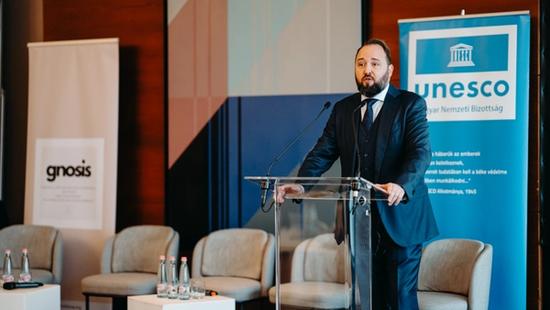
Next, Erik Molnár Jr., Director-General of the Gnosis Institute, delivered a short but clear speech outlining the purpose of the event. The region faces significant challenges: the international system, the climate, and security structures are undergoing profound changes. In such times, the value of understanding, co-operation, and finding a common language becomes priceless for building a better future. This event, organised on neutral ground, seeks to foster connections and share best practices from across the region to support social and economic development. He concluded on this high note and invited Gábor Soós, Secretary-General of the Hungarian National Commission for UNESCO, to offer his thoughts and deliver a welcome address.
Mr Soós stated clearly that throughout human history, people have had to struggle against nature, against other people, or against regimes. But UNESCO’s credo is that war begins long before the first act of physical aggression: every war starts first in the human mind, if people allow room for it. We must all redefine peace, which cannot simply be the absence of war, but rather a condition maintained through humble, everyday work. Peace is a cultural achievement of humankind that can develop only within certain ecological contexts. Therefore, humanity must face the pressures created by climate change with ecological resilience and peace in mind. To achieve this mindset, one must cultivate cultural openness towards other peoples, uniting to bury old scars through the power of reconciliation. To foster such openness, we must view each other’s diverse heritages as resources. Social stress, political shifts, and ecological challenges may result in trauma — but only if we fail to keep peace at the forefront of our minds.
After these words of wisdom, Ambassador László Eduárd Máthé, Hungary’s Special Envoy for the Sahel delivered his keynote speech to the audience. He underlined that foreign policy is in constant flux, and therefore even a small, landlocked country like Hungary can play its part in offering a helping hand to those in need.
He briefly summarised Hungary’s actions towards the Sahel region: beginning in 2022, the breakthrough came in July 2023, when one of the most stable states in the area, Chad, formed bilateral connections with Hungary and became a pilot project for Hungary’s humanitarian aid. He admitted that many ordinary citizens often question Hungary’s involvement, but he always replies that even the UN states that countries must reinforce systems and provide assistance when a humanitarian crisis occurs — and Hungary is simply taking its share of this noble work. However, unlike a few other countries’ models, Hungary seeks to keep the relationship clearly on a partnership basis.
He continued by speaking about areas in which Europeans need to develop: first, we should forget the maps with neat rectangular borders and change our mindset to view everything through geopolitical lenses, welcoming any new insights we gain this way. We must all understand how religions, anthropology and culture function in the region, because crises do not recognise borders. Ending his speech on an optimistic note, he spoke about the important steps already taken, as all the students taught within this programme will carry the good memory of their teachers with them for as long as their hearts beat.
The first panel entitled “Sahelian Regional Cooperation in Transition” was moderated by Tamás Baranyi, Director for Strategy of the Hungarian Institute of International Affairs. He stated that he views the Sahel region as resources and opportunities. His Excellency Mr Adel Talbi, Ambassador of Algeria in Budapest, pointed out that the greatest problems in the area were mainly linked to the continual presence and actions of terrorist organisations. Dealing with these elements must be the overall priority for every state in the region. In addition, the region’s economic fragility holds back the formation of cohesive societies. People here face numerous challenges, but they must understand that regardless of which side of the state borders they live on, they are all brothers: the geography is the same for all, the culture is the same for all, and even the meaning of “Sahel” is the same for all of them. He noted that Algeria was the largest country in Africa but strives to maintain brotherly relations with other states in the region, helping them achieve stability and security. Algeria continually monitors the development of terrorism, illegal weapons and other criminal activities to identify and address their root causes. The system they seek to promote stands on three pillars: counterterrorism, proactive and preventive diplomacy, and sociocultural development.
Ambassador Máthé offered a different perspective, even stating that Chad is already trying to build a highway to Egypt’s greatest port, Alexandria — a 1,720 km-long road including projects aimed at better regional development. He said that here in Europe we could hardly imagine the cultural richness along such a thousand-mile route; therefore, we must first take the necessary time to recognise the diversity and unique heritage. Only after we express our most honest awe should we consider what steps we believe are necessary. He added that the Central European approach may differ from that of those who come to the region solely for raw materials.
The next panellist, His Excellency Mr Siddig Mohamed Abdalla Mohamed, Ambassador of the Republic of Sudan to Hungary, expressed his worries about the insurgencies in the area. He noted that before 2011, when South Sudan declared independence, his country had been even larger than Algeria, and now — after losing one third of its territory — it was still the third biggest country on the continent, behind Algeria and the Democratic Republic of the Congo. This vast area borders seven neighbouring countries (eight if Saudi Arabia is counted on the opposite side of the Gulf), showing that Sudan has enormous strategic potential, but must rise to the role. He stated that many external actors viewed the region merely as an exporter of problems, but he is certain that insurgencies are financed by foreign sources. He added that those supporting “freedom fighters” must have understood that they were pouring oil on a fire and instead should direct their support towards peaceful solutions.
The fourth member of the panel, France Mutombo, President of the Foundation for Africa, said that he came to Hungary from Congo twenty years ago, and this life experience enables him to view the region from both perspectives. He recapped relations between Hungary and Africa, noting that over the last 10–15 years, policy had shifted towards greater openness on both sides, creating a new and effective framework for providing assistance. He remarked that every crisis contains not only a threat but also an opportunity. He highlighted that governmental ties can help form business connections, which in the long run allow both countries’ economies to benefit. He also thanked the Gnosis Institute for organising this event as a dialogue rather than a paternalistic lecture. Openness, listening to one another, and equal footing are essential for building systems that endure.
From his perspective, the coalition formed by Burkina Faso, Mali and Niger recently can serve as an example for acting independently to address the region’s challenges, while many larger African unions are simply waiting for Western countries to tell them what to do. He concluded by summarising the essence of his vision: an egalitarian dialogue is needed, after which governmental connections can encourage the business sector, societies, and private individuals to engage and form bonds that will continue to function even if the governmental sector later withdraws.
After the first round of interventions, Baranyi asked the panellists how we should all approach Africa. Ambassador Talbi said that in Europe borders acted like fences, whereas in Africa they were more like markings on a map. The people of the Sahel have always had to move according to the changing conditions of nature, because remaining in one place may mean death. For this reason, states in the region struggle to maintain control and security. New problems are also emerging: in 2007, deaths caused by terrorist action accounted for around 1%; now, in certain regions, they may represent up to 50%, and no one can ignore this.
He defined four key points of the crisis: political instability; the collapse of constitutional systems in the area; weak border control; and poverty, as the lack of employment pushes large numbers of people to make a living as mercenaries for terrorist groups (according to UN reports). Lastly, illegal migration. He emphasised that terrorists now used drones to carry out attacks and were slowly taking control of vast rural areas — up to 60% of a country. Algeria introduced a policy some time ago banning ransom payments for Algerians, and since then terrorists have avoided capturing Algerians. However, to track terrorist groups, states should maintain stronger control over the internet, as this is how extremists communicate and organise themselves.
In response to the same question, Ambassador Mohamed Abdalla Mohamed shared his experience that Africans often received largely unrealistic suggestions without being given the opportunity to express their own point of view, and that genuine dialogues such as this — which can build bridges of understanding — are rare. He recalled that in 2004, during the crisis in Rwanda, the international public had declared that such an event could have never happened again; however, a Sudanese city endured a 500-day siege by insurgents before the UN finally decided to act. The siege appeared in news broadcasts worldwide, but the conflict had already long existed and could have been prevented if the major powers had shown the will to intervene. He advised Western audiences to understand first, and only then attempt to teach. Concluding the panel, Mutombo summarised the main takeaways in two sentences: African problems need African solutions, and “think globally, act locally” is the only way to manage the problems of the continent.
The second panel with the moderation of Erik Molnár Jr., General Director of the Gnosis Institute focused on the security issues of the region, placing transformation, innovation and development into context. The first speaker, Jaouad Mohamed Malzi, Non-resident Research Fellow (Morocco) at the African Studies Centre, Metropolitan University Prague joined the event online and covered a broad range of economic and social issues, identifying the root problem as the fragility of the energy supply. He said that the capacity for storing electricity was very low and that the region could exploit the opportunities provided by solar energy. State funding alone is not enough, but expanding the infrastructure could act as a catalyst for private initiatives. He is certain that any investment in the energy sector would pay for itself over time, as energy consumption is constantly rising. Summarising his speech, Mr Malzi drew attention to regional realities and stated that sustainability would have to overcome the resistance of climatic factors and sometimes even governmental obstacles, but local communities desperately need this sustainability, and international stability also demands that these steps to be taken. The Sahel, he said, is the place for realising visions.
The next panellist, Danilo Babić, Research Fellow at the Institute of International Politics and Economics in Serbia, introduced the European Union’s Global Gateway plan and made several recommendations. First, he emphasised that it would not produce good outcomes if it was directed against the positions of other major powers; it would work and bring results only if it was directed towards Africa itself. It must be implemented in a way that avoids creating tiny economic enclaves, instead acting as a catalyst for the transformation of the entire region. Three questions must be asked repeatedly to stay on the right path: Who benefits? Who pays? Who decides? He suggested that private capital could be invested profitably in renewable energy, mini-grids, optic cables, telecommunications and, last but not least, logistics corridors.
He acknowledged that European bureaucracy operated with strict rules to ensure transparency, but in this case the over-bureaucratic model could become more of a barrier than a pathway. He advised keeping paperwork as light as possible while maintaining transparency. He then compared the BRI with the Global Gateway and suggested that the EU should not try to bring more steel and concrete to the region than China; however, through high-quality projects and sophisticated systems, the EU can rise to the position of a key partner. This will happen only in the long run, so the EU should not abandon the project even if it initially secures only a minor position in raw infrastructure.
The panel discussion continued with Chigozie Nweke-Eze, Visiting Fellow of the Africa Programme of the European Council on Foreign Relations, who described Africa and the Sahel as lands of great potential and resources, but noted that the central issue was energy. Returning to Mr Babić’s three questions, he said that consistently applying them could lead to sustainability. He firmly believes that investor profit, broader social benefit and environmentally sound decisions can go hand in hand. He highlighted that good and intelligent infrastructural development can lay the groundwork for private-sector initiatives to create workplaces.
Next, Abdelkader Abderrahmane, Advisory Expert at Upinion from the Netherlands, spoke about security issues and described the situation as a theoretically half-empty glass. He stated that even humanitarian tools like Starlink can become weapons in the hands of terrorists. He argued that the G5 cooperation in the Sahara region was established on a mistaken premise, as it suggests that the region’s problems are confined to only five countries. We must view the area as a geographical entity, because sub-Saharan, West African and North African problems are different expressions of the same root causes, and dividing them is of no use. He emphasised that concepts such as the G5, Sahel and sub-Saharan region are all East–West oriented, whereas the problems are North–South oriented, such as the spread of extremist groups. He also noted that fifteen years ago there were ten major conflicts on the continent, ten years ago there were fourteen, and today there are forty. He stressed that whoever controlled Mali controlled West Africa, if not the entire continent — and terrorist groups appeared to understand this. Governments must adopt a holistic approach and break with the tradition of allowing terrorists to act while merely reacting afterwards.
Then Mr Molnár asked Mr Babić what he had learnt about the region during his research. Mr Babić drew parallels between the Yugoslav dissolution and the region’s history. He recalled that the Carrington–Cutilero Peace Plan could have ended the Yugoslav wars in 1992 but was broken by people in power who believed they could gain more from continued conflict. Almost the same agreement was finalised in Dayton three years and 100,000 victims later. This sequence of events served only one purpose: to demonstrate to local people that they were too small to reach a functioning agreement on their own and would always need external arbitration. He also noted that, in the eyes of Europeans, the Sahara is an impassable natural border — but it is not for Africans.
To conclude, Mr Molnár asked the panel how the region might achieve sustainable peace. Abderrahmane stated that this could happen if investments prioritise cooperation with civil society rather than governments. Nweke-Eze suggested that every investment should be assessed by professional risk and security managers, and added — difficult as it is to say — that to keep pace with the times, everyone must learn what terrorists already practise: working across borders. Babić added that there were plenty of examples, such as the Balkans, and that we must understand that development cannot be rushed beyond what a society can bear, though we may avoid repeating certain mistakes if we learn from the past.
The next presentation was given by Melinda Gitta Szeles, Sahel Region Director of the Hungary Helps programme. She began with highlighting the complex challenges and causes of humanitarian crises in the Sahel that forces large part of local communities to leave their homes. She introduced the work of Hungary Helps, which has already brought hope and development to the region. They have several initiatives in Chad, Mali, South Sudan and Nigeria, and they also helped rebuild schools in Libya after a devastating sandstorm. Their main activities focus on health and education infrastructure and services, but this has recently expanded to include a revolutionary camel-milk processing factory and welder training, helping people develop new skills and a new mindset.
The third panel was about the positive spillovers of actions taken in the region and was moderated by Hanga Horváth-Sántha, Senior Research Fellow of the Hungarian Institute of International Affairs. The first guest, Gábor Gremsperger, Founder & CEO of Climate Action ESG Solutions Kft from Hungary, told their story: they are a small company focusing on carbon and waste management, but they wanted to build a strong social branch in their enterprise, so they launched a programme in sport and sustainability. Their initiative has shown that even a single programme can bring together generations, give young players perspective, keep professionals in the field, and reactivate retired talents to serve as role models and coaches for the next generation.
Next, Tanya Kyriakidou, President of the A.S.T.E.R.I. NGO, introduced their initiative. She underlined that sport can lead to a better future because even when politics fail, games can still remain a platform for communication. To make sure everyone has the chance to discover their unique talent, they include less-known sports in their programme as well. They always set measurable and achievable goals, which they consistently reach, showing how a few wisely spent dollars can have a significant effect on people’s lives and hopes for a better future. She stressed how important it is for young people to see professional athletes as examples of success — if they can picture a livelihood in sport, they are less likely to join extremist groups.
The next speaker was Adama Diarra, Honorary Consul of Mali in Hungary, who emphasised how important such initiatives were by pointing to the alternative: people joining extremist movements because they see no hope. He highlighted how fiercely Mali was fighting these terrorist groups, and that now there were three states following this policy, open to new participants. He stated that obtaining a visa (even for educational purposes) to the EU was very difficult, which made social transformation even harder. He also noted how enlightened Hungary’s method was, as it listened attentively to what local society needs and cooperates, instead of bringing its own models from home as others did during colonisation. In conclusion, he responded to critics who say that Hungary is a small country whose help cannot make much difference by sharing a saying from Mali: even if the pepperbox may seem to be empty, you can still sneeze from it.
Horváth-Sántha asked some specific questions about the ongoing initiatives, and Kyriakidou revealed that she and Gábor Gremsperger had already agreed the day before to start a new joint project. Gremsperger added that there is a great deal of money in football, and the value of one discovered talent could cover the entire recruitment programme, through which many people’s lives could change for the better even if they do not become professional players. Kyriakidou added that one of their new initiatives was to combine sports, dance and music into viral social media reels, making participation desirable to the next generation.
After this session, there was time to include viewpoints from the audience as well. One native African attendee emphasised that Pan-African communities must make a self-reflection about the reasons why it had not managed to solve crises on their own and ask the following questions from themselves: Why do we have this learned helplessness? Why do we wait for others to take care of us? He said that he believed decolonisation happened almost by accident, and many of its structures still existed. In his opinion, the whole continent must undergo a process of structural decolonisation to create an even ground for a fair restart. He also argued that countries must break the tradition of teaching the geography of great powers more thoroughly than that of their own neighbours.
The last panel focused on culture and education and was moderated by Anna Orosz, Head of Research of the Gnosis Institute. The first speaker, who joined the conference via video call, was Jesutimilehin O. Akamo, Coordinator of the Research and Policy Analysis Unit of the Africa Peace and Security Programme at the Institute for Peace and Security Studies. He is involved in many projects addressing the local educational crisis. He emphasised that changes happen so quickly that when a group of teachers arrives at a refugee camp, the people are often forced to move again, meaning that many school-aged children have no access to real education. The best solution, he argued, was to introduce mobile schools, in which teachers move with the same group of children, providing stability in their lives.
The greatest problem, he said, is that even some adults do not believe education makes any difference, and extremist groups and extremist acts become part of everyday normality when people have no access to the wider world. He told the audience the dark truth revealed by recent studies: while lack of education makes people unable to pursue qualified jobs and therefore easy recruits for terrorist groups, education itself does not prevent people from joining the same groups — it may even make them more dangerous. In his final thoughts, he noted that there were many initiatives, and many showed success; they must be further developed and spread throughout the region, and results will come.
Next, Zsolt Szirmai, Head of the Unit for Bilateral Relations of the Department for Stipendium Hungaricum at Hungarian Ministry of Foreign Affairs and Trade, gave his presentation. The Stipendium Hungaricum project has been offering tuition in Hungarian universities since 2013, and over the years more than 10,000 students from over 100 countries have participated. Its aim is to promote cultural and educational exchange and to forge personal and professional ties. The programme includes 32 Hungarian universities — almost all of them — and covers tuition fees, medical insurance and contributes to living costs. Twenty per cent of the students come from Africa. After completing their studies, many return home and apply their knowledge locally, supporting their communities and economies.
The next speaker was Bujar Luma, Executive Director of the Center for Balkan Cooperation LOJA from North Macedonia, who shared his own experiences of how reconciliation has been achieved in the Balkans over the last 25 years. They created an initiative through which teachers received “peace programme” training, which included mindset development and techniques to facilitate case discussions. More than 40 universities have joined, rejecting grievances. Their journalists also follow strict regulations encouraging them to highlight examples of successful cooperation. It is essential, he said, to remember that peace does not stay with us without effort — it must be achieved and maintained through constant work. He recalled that in medieval times, when there were no methods of telecommunication, Balkan households kept an extra room — the nicest one — always with a clean bed and the best food prepared in case a guest arrived. In this spirit people can live together, because culture is always worth more than any signed document.
The last speaker in the session was Sándor Horváth, Project Leader at the Hungarian Baptist Aid. He spoke about the current situation of education in Chad. In a country where 60% of the population is under 25, education would be crucial, but access is very limited, and there is even a shortage of teachers. Low enrolment and high dropout rates characterise every level of education, and foreign language, marketing, digital and financial skills are rarely taught. Despite the great potential, the private sector is still not involved in school funding, which could serve as an innovation hub. He called for action because these challenges are real, and we cannot allow so much talent to go to waste.
After this final discussion, Péter Miletics, geopolitics lecturer at Milton Friedman University, Hungary, gave a short presentation entitled “Africa: the continent without history”. The tile was intentionally misleading. He identified three independent cradles of African civilisations and focused on West Africa to match the event’s theme. In a few minutes, he took the audience through time and space, highlighting the Ghana, Mali and Songhai Empires, their majestic sizes and their achievements over the centuries. The region’s decline began in 1590, when the troops of the Moroccan Sultanate conquered the area; by 1639 the soldiers had left, leaving the region fragmented until European colonisers arrived. In response to his own title, he concluded that Africa is a great continent with a vast history of which it can be proud. If we are looking for a place without history, he said, we must look elsewhere — perhaps Antarctica, though he is not even certain of that.
Closing the event, Erik Molnár Jr., General Director of the Gnosis Institute, stepped onto the stage once again and thanked everyone for their attendance. He promised that the Institute would organise a similar event next year and invite the speakers to present the successes achieved — even within a single year. He summarised the event’s importance: it may have been a small spark, but even great fires begin with little sparks.
Newsletter
Contact us!
text
Copyright 2026